Wire gauge sizes measure the diameter of a wire, which determines its current-carrying capacity, resistance, and suitability for specific applications. The system is standardized using different gauge scales, with American Wire Gauge (AWG) being the most common in North America. Here’s an overview of how wire gauge sizes work:
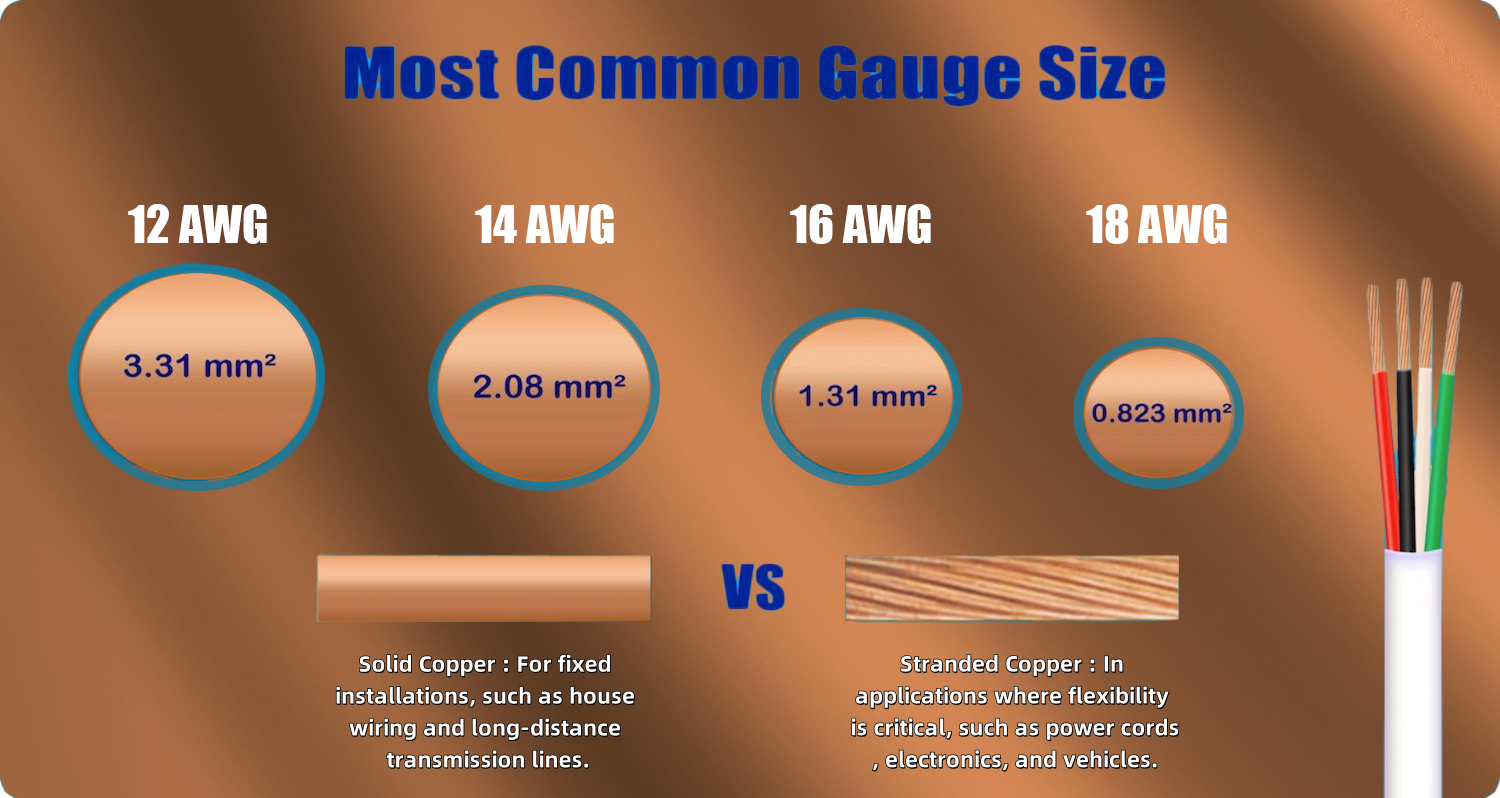
Understanding AWG:
Inverse Relationship:
As the gauge number increases, the diameter and current capacity of the wire decrease. For example, 12 AWG is thicker than 18 AWG.
Wire Gauge Sizes Range:
AWG sizes typically range from 0000 (4/0) (largest) to 40 (smallest). Larger wires (lower gauge numbers) can carry more current and have lower resistance.
Key Features of American Wire Gauge:
1. Diameter Measurement:
The wire’s diameter is measured in inches or millimeters. A thicker diameter means less resistance and higher current-carrying capacity.
2. Resistance:
Thinner wires (higher gauge numbers) have more electrical resistance, which can lead to heat buildup if the wire carries more current than it can handle safely.
3. Ampacity (Current-Carrying Capacity):
Each gauge size has a maximum current it can safely carry without overheating. For instance:
- 14 AWG: Typically handles up to 15 amps.
- 12 AWG: Typically handles up to 20 amps.
4. Material Impact:
Conductivity varies depending on the material (e.g., copper, aluminum). Copper wires carry more current than aluminum wires of the same gauge.
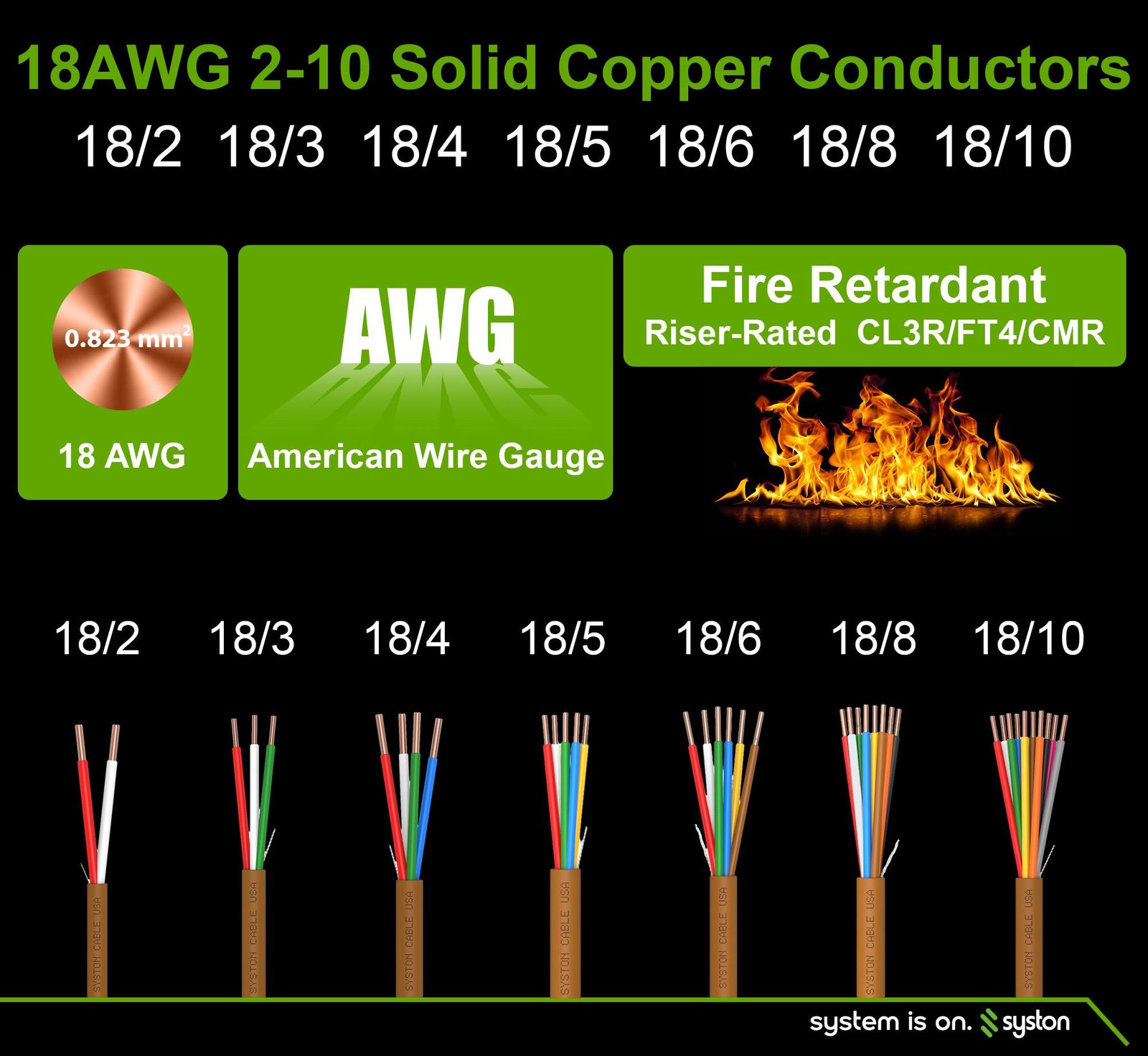
Syston Cables are exclusively made with copper conductors and never use inferior aluminum conductors as a substitute, such as with these Thermostat Wires – Lower electrical resistance due to the single, continuous structure. Suitable for high-current applications. More resistant to corrosion and mechanical wear in static environments. Generally less expensive to manufacture and purchase due to the simpler design. You can always trust Syston!
Why Wire Gauge Size Matters?
- Safety: Using an undersized wire can lead to overheating, potential fire hazards, and voltage drops.
- Efficiency: Thicker wires reduce energy loss due to resistance, making them better for long-distance power transmission.
- Compliance:Electrical codes specify minimum wire gauges for different applications, like residential wiring or industrial use.
Common Applications by Wire Gauge:
- High Current Applications:Low gauge wires like 4 AWG for heavy-duty electrical systems, such as car batteries or industrial machines.
- Household Wiring:Mid-range gauges like 12 AWG or 14 AWG for outlets, lights, and general home wiring.
- Electronics:Higher gauge wires like 20-30 AWG for smaller devices or delicate circuitry.
Here’s a detailed chart for AWG wire gauge sizes, including their diameters, current-carrying capacities (ampacities), and common applications:
AWG Wire Size Chart
| AWG Size | Diameter (Inches) | Diameter (mm) | Ampacity (Amps) | Common Applications |
| 0000 (4/0) | 0.4600 | 11.684 | 195-260 | Large power cables, industrial equipment |
| 000 (3/0) | 0.4096 | 10.405 | 165-225 | Heavy-duty welding, large motors |
| 00 (2/0) | 0.3648 | 9.266 | 145-195 | Large generators, main power lines |
| 0 (1/0) | 0.3249 | 8.251 | 125-175 | Heavy appliances, industrial machines |
| 1 | 0.2893 | 7.348 | 110-150 | Power distribution in commercial settings |
| 2 | 0.2576 | 6.544 | 95-130 | Main residential service cables |
| 4 | 0.2043 | 5.189 | 70-95 | Subpanels, high-power lighting |
| 6 | 0.1620 | 4.115 | 55-75 | Household wiring for cooktops, HVAC |
| 8 | 0.1285 | 3.264 | 40-55 | Small appliances, air conditioners |
| 10 | 0.1019 | 2.588 | 30-40 | Water heaters, small tools |
| 12 | 0.0808 | 2.053 | 20-30 | Residential outlets and lighting |
| 14 | 0.0641 | 1.628 | 15-20 | General lighting circuits |
| 16 | 0.0508 | 1.291 | 10-15 | Doorbells, thermostats, low-power electronics |
| 18 | 0.0403 | 1.024 | 5-10 | Small electronic devices, hobby wiring |
| 20 | 0.0320 | 0.812 | 3-5 | Internal electronics wiring |
| 22 | 0.0253 | 0.644 | 2-3 | Data cables, alarm systems |
| 24 | 0.0201 | 0.511 | 1-2 | Signal wires, communication lines |
| 26 | 0.0159 | 0.405 | 0.5-1 | Headphone cords, microelectronics |
| 28 | 0.0126 | 0.320 | 0.2-0.5 | Delicate wiring, low-power LEDs |
| 30 | 0.0100 | 0.255 | <0.2 | Precision electronics |
Notes:
- Ampacity:Varies based on installation (e.g., in conduit or free air) and insulation type. Always consult local electrical codes.
- Voltage Drop:For long distances, use a lower gauge (thicker wire) to reduce resistance and voltage drop.
- Material:Values are for copper wire. Aluminum wire has a lower ampacity and requires a larger size for equivalent performance.
How To Choose The Right Wire Gauge Sizes?
When selecting the appropriate wire gauge size for an application, several key factors must be considered, particularly the amperage rating of the circuit. Higher amperage ratings require thicker wires to handle the load without overheating. If the wires are too thin for the amperage, they may fail or even pose a fire risk.
To ensure safety and efficiency, it’s important to determine the total amperage of your system before choosing a wire gauge. An electrician can assist by calculating the planned load, connected load, and circuit length. Once these factors are clear, you can select a wire that suits the requirements.
While gauge primarily refers to a wire’s thickness, it also indicates other technical specifications. For example, there’s a direct relationship between a wire’s gauge and its diameter, resistance, and capacity. Here’s what you can deduce by knowing the wire gauge:
- Diameter:Lower gauge numbers indicate larger diameters, while higher numbers represent smaller diameters. For instance, AWG 40 has a diameter of 0.0031 inches, while AWG 4 measures 0.2043 inches. The diameter doubles with every six-level decrease in gauge size, so a 3-gauge wire is twice as thick as a 9-gauge wire.
- Area: The cross-sectional area of a wire can be calculated using the formula A=πr2A = πr^2A=πr2, where rrr is half the diameter. The cross-sectional area doubles for every three-level decrease in gauge size. For example, a 6-gauge wire has twice the cross-sectional area of a 9-gauge wire.
- Feet per Pound:This refers to the length of wire (in feet) required to weigh one pound. For instance, AWG 4 wire requires 7.918 feet, while AWG 40 requires 34.364 feet.
- Resistance:Measured in ohms per 1,000 feet, resistance depends on both wire length and thickness. Longer wires have higher resistance, but thicker wires of the same length have lower resistance. For example, AWG 4 wire has a resistance of 0.2485 ohms per 1,000 feet, while AWG 40 has 1,079 ohms for the same length.
- Current Capacity (Amps):Thicker wires (lower gauge numbers) can carry more current because they allow more electrons to flow.
By understanding these relationships, you can select the right wire gauge size for your specific needs. Have more questions? Feel free to reach out! Our experts are ready to help you find the perfect cable solution. Visit our website, check out our Facebook or contact us directly for more information.